Tell us about the job
Takes about a minute. No obligation.
A contractor quoting a central AC installation in Johnston County has to account for what the climate here actually asks of equipment before they can spec the right system. 202 severe weather events were recorded in Johnston County, North Carolina between 2015 and 2024. At that rate, severe weather is a standing feature of this area, and a system sized without accounting for that recurring load gets underbuilt for the conditions it will face from its first season. Duct layout, equipment capacity, and refrigerant line placement are all local decisions here, not catalog defaults.
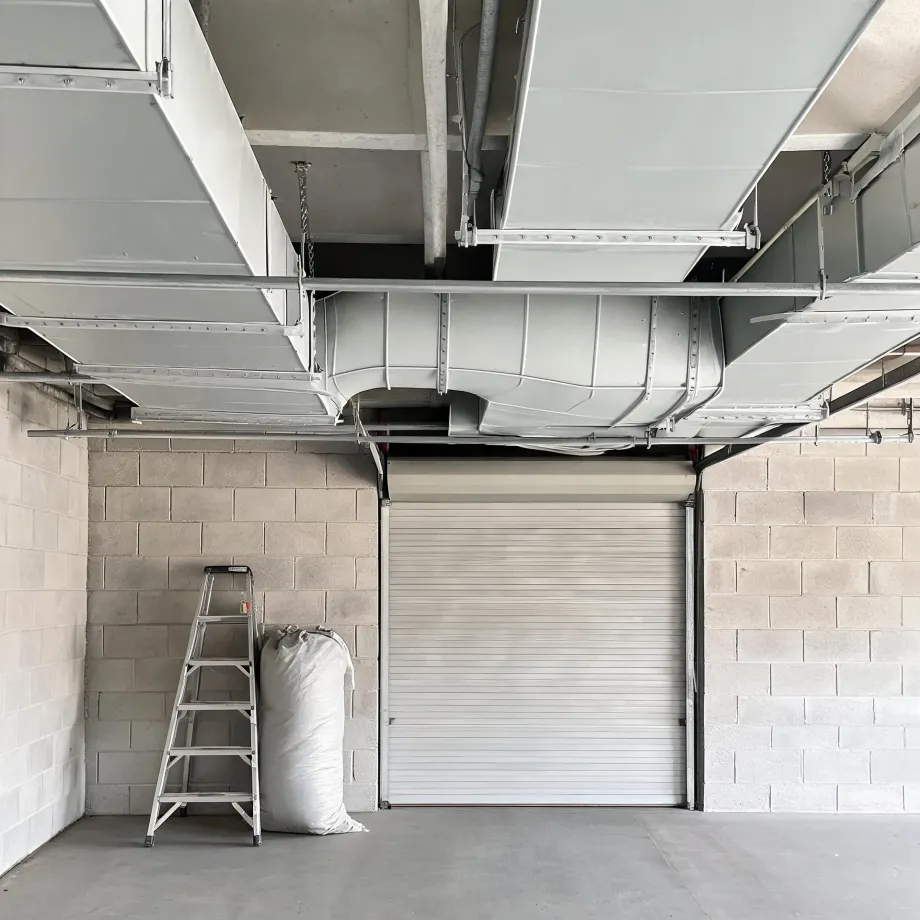
Ductwork installed around the median year in this county was sized for equipment that drew loads similar to what a modern central AC unit demands. That alignment matters when a contractor prices a new system, because the ducts are often serviceable without replacement, and the quote reflects that. Half the homes in Johnston County, North Carolina were built in 2000 or earlier (2020-2024 ACS 5-year). A house where the existing ductwork can carry a new system without modification is a different job than one where it cannot, and the electrical panel in stock of this vintage was built to a standard that modern residential units typically fall within. The variables a contractor has to open and measure here are real, but the building itself is less likely to be the obstacle.
What Gets Installed With a New Central AC
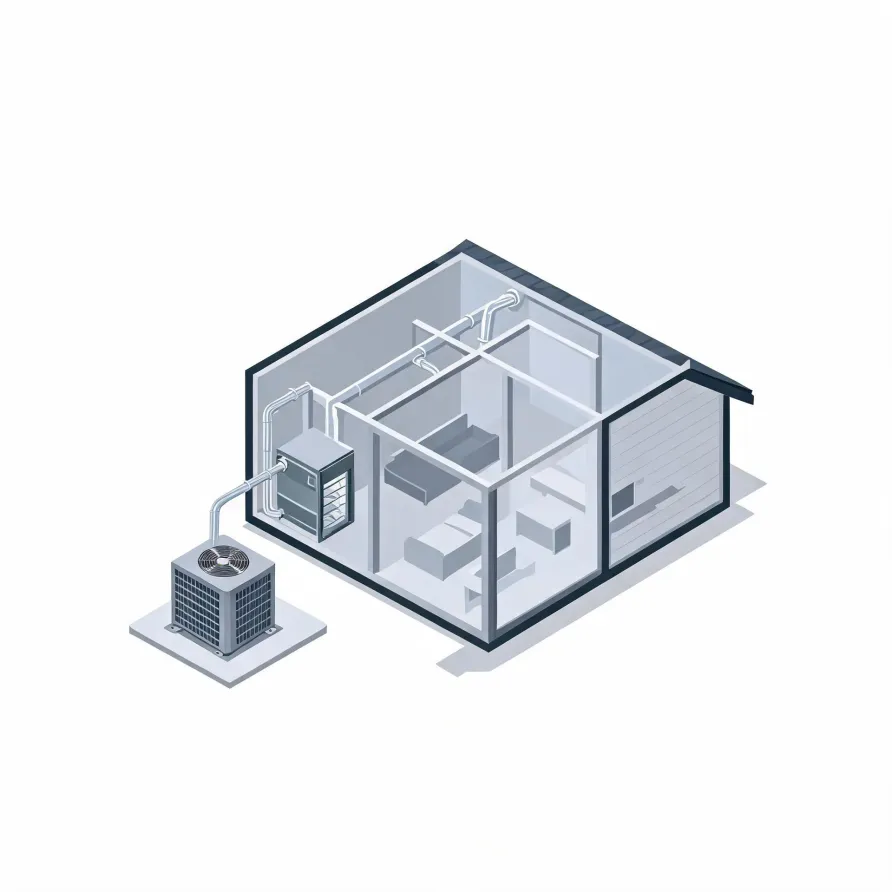
The outdoor condenser unit sits on a concrete pad beside the house and holds the compressor and condenser coil, the two components that do the heaviest work in the system. Inside, the air handler mounts in a utility closet, basement, or attic and contains the evaporator coil and blower that move conditioned air through the home.
The thermostat goes on an interior wall and gives the homeowner control over the whole system. A contractor also installs the refrigerant line set, a pair of copper lines that run between the air handler and the condenser unit, along with a disconnect box mounted near the outdoor unit.
The drawing shows a typical layout, and a licensed contractor determines exactly what applies to this house.
Find a contractor in Johnston CountyJohnston County, by the numbers
202 severe weather events were recorded in Johnston County, North Carolina between 2015 and 2024.
NOAA National Centers for Environmental Information, Storm Events Database, bulk CSV export, events 2015-01-01 through 2024-12-31.Half the homes in Johnston County, North Carolina were built in 2000 or earlier (2020-2024 ACS 5-year).
U.S. Census Bureau, 2020-2024 American Community Survey 5-Year EstimatesJohnston County, North Carolina holds 91,218 housing units (2020-2024 ACS 5-year).
U.S. Census Bureau, 2020-2024 American Community Survey 5-Year EstimatesOwners occupy 76.1% of the occupied homes in Johnston County, North Carolina (2020-2024 ACS 5-year).
U.S. Census Bureau, 2020-2024 American Community Survey 5-Year EstimatesRules & Standards for Central AC Installation in Johnston County, North Carolina10 sourced rules and standards
What happens when the contractor shows up
Split-system central air conditioners rated below 45,000 Btu/h manufactured on or after January 1, 2023 must meet a federal minimum of 13.4 SEER2.
Split-system central air conditioners rated at or above 45,000 Btu/h manufactured on or after January 1, 2023 must meet a federal minimum of 13.4 SEER2.
Split-system central air conditioners manufactured between January 1, 2015 and December 31, 2022 had to meet 13 SEER, the metric that preceded SEER2.
Single-package central air conditioners manufactured on or after January 1, 2023 must meet a federal minimum of 13.4 SEER2.
Space-constrained central air conditioners manufactured on or after January 1, 2023 must meet a federal minimum of 11.7 SEER2.
Federal efficiency standards for split-system central air conditioners and heat pumps are set on each certified combination of outdoor unit and indoor coil rather than on the outdoor unit alone.
Residential and light commercial air conditioning and heat pump systems assembled in the field, including mini-splits and unitary systems, may not be installed on or after January 1, 2025 using a refrigerant with a global warming potential above 700.
A field-assembled system whose specified components were all manufactured or imported before January 1, 2025 carries no installation compliance date under the refrigerant restrictions and may still be installed.
Licensing and Legal Requirements in Johnston County, North Carolina
North Carolina issues Class I heating licenses covering all systems in all structures, and Class II licenses covering heating systems in single-family detached residential dwellings.
North Carolina requires a license before any person or firm may engage in, or offer to engage in, the business of heating contracting.
Severe Weather Events in Johnston County
Weather puts a load on HVAC equipment, and that load varies by location. How hard a system has to work over its lifetime depends on what the climate around it actually does, which is why local weather history belongs on a page about installation.
202 severe weather events, 2015–2024. Source: NOAA National Centers for Environmental Information, Storm Events Database.