Tell us about the job
Takes about a minute. No obligation.
A contractor quoting a central AC repair in Edgecombe County will ask about the age of the equipment and how it has been maintained before drawing any conclusions about weather. 67 severe weather events were recorded in Edgecombe County, North Carolina between 2015 and 2024. At roughly that rate, severe weather is an occasional fact of life here, and most systems will fail for the reasons systems fail everywhere: worn capacitors, refrigerant loss, compressor fatigue from years of summer load. Reaching for the weather record as an explanation is usually the wrong call. A contractor who establishes what the equipment has actually been through delivers a more accurate diagnosis and a repair scope that holds.
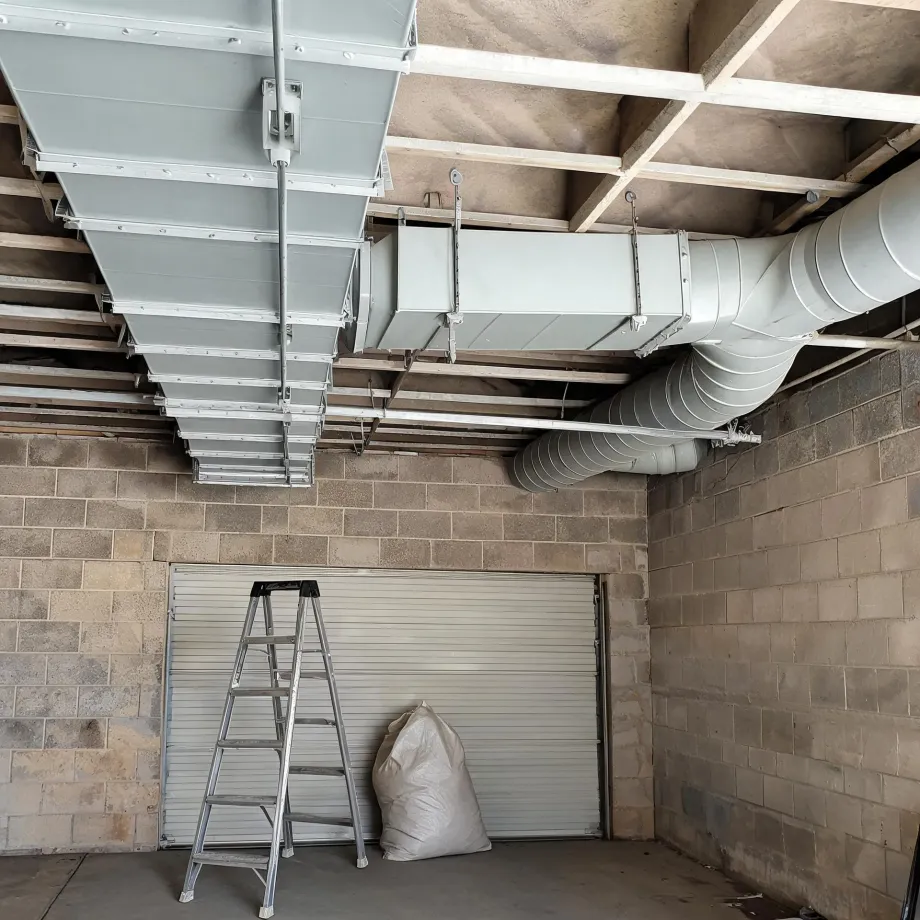
Central AC equipment installed in a house built generations ago has already outlasted its original parts at least once. Half the homes in Edgecombe County, North Carolina were built in 1978 or earlier (2020-2024 ACS 5-year). A contractor opening a system in stock like this finds compressors, capacitors, and contactors that have been substituted before, sometimes with whatever was available rather than what the unit was designed to take. When a part fails today, the question is whether a current supplier still makes it in the spec the system requires. If they do not, the repair becomes a sourcing problem before it becomes a technical one.
The Parts of a Central AC a Contractor Checks First
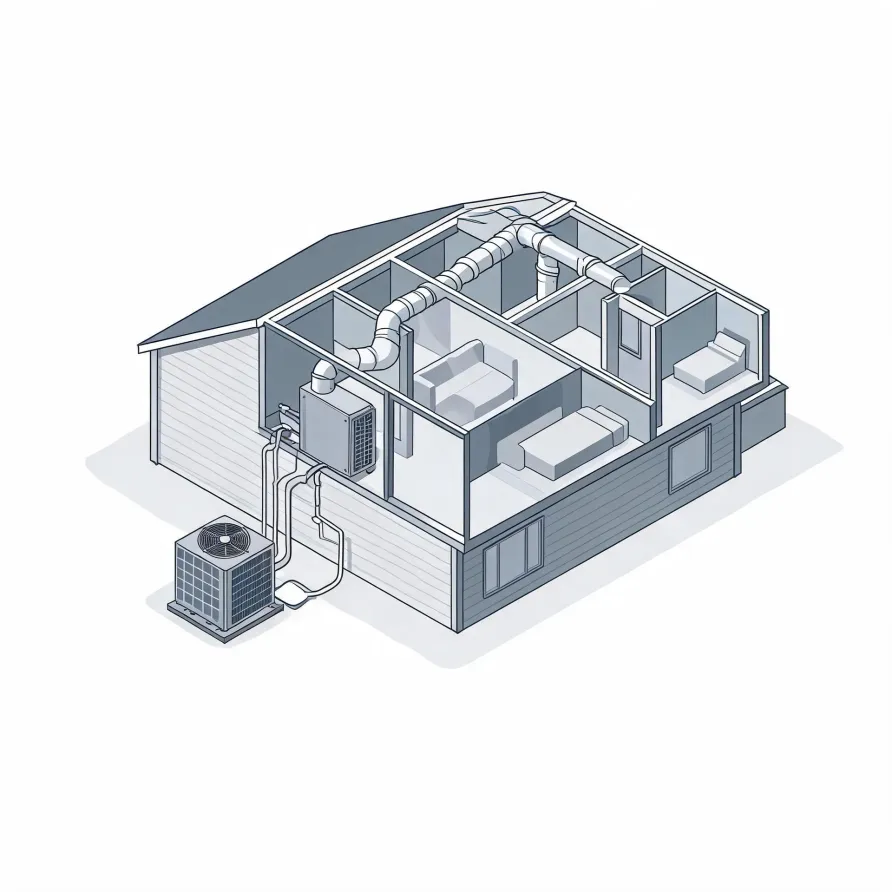
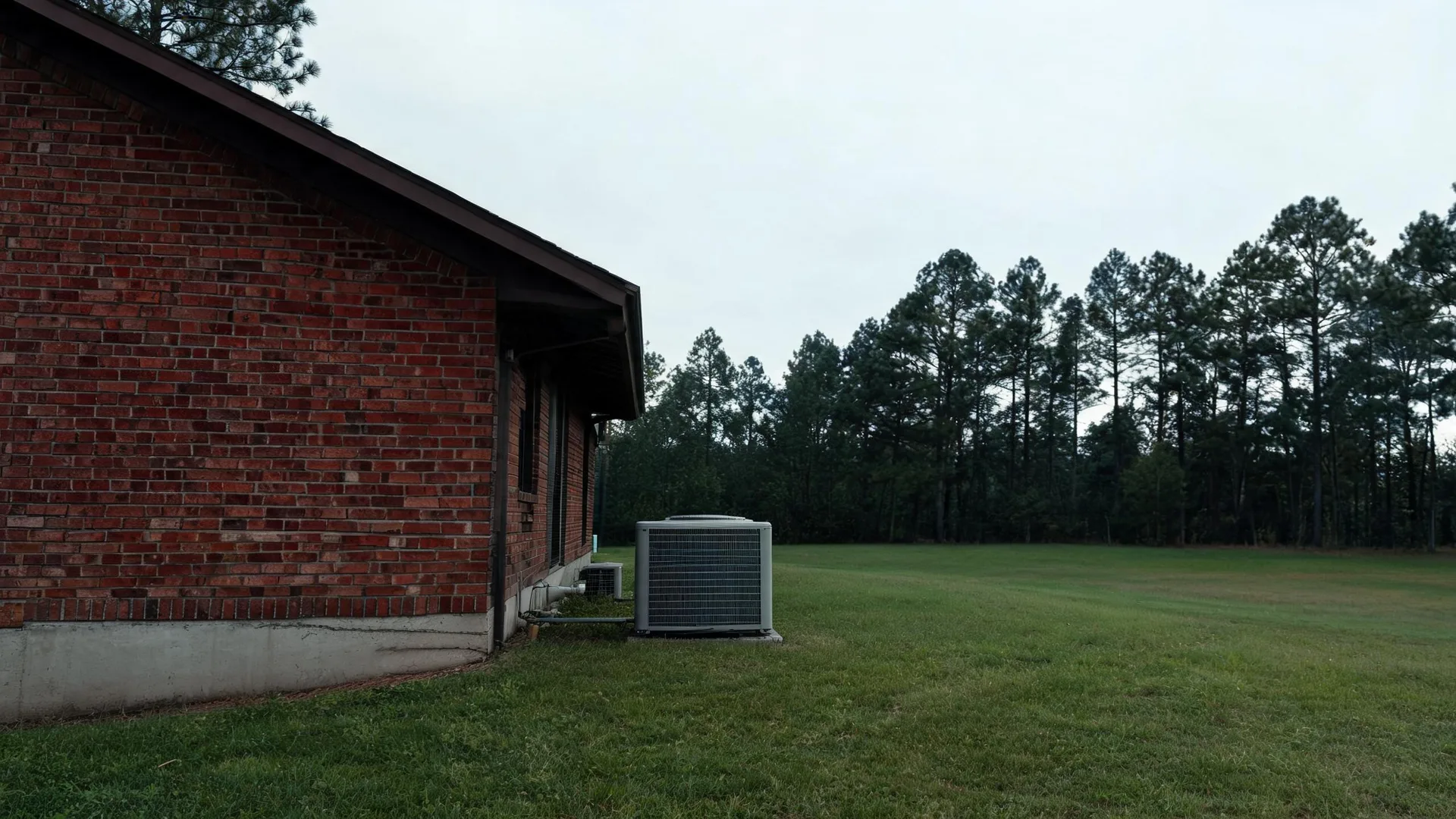
The outdoor condenser unit sits on a pad outside the house and holds the compressor and condenser coil, the two components a contractor reaches for first when a system stops cooling. The compressor is the heart of the refrigerant circuit, and when it fails, the whole system goes down. The condenser coil sheds heat to the outside air, and a fouled or damaged coil shows up fast as warm air inside.
Inside the house, the air handler holds the evaporator coil and the blower. The evaporator coil is where the cooling actually happens at the indoor air, and a refrigerant leak or a frozen coil points back here. The blower moves conditioned air into the ducts, and a failed motor or a clogged filter can make a system seem broken when the fix is straightforward. The refrigerant lines connecting both units and the thermostat on the wall round out what a contractor examines.
The drawing shows the general layout of a central AC system, and a licensed contractor determines what applies to your specific house.
Find a contractor in Edgecombe CountyEdgecombe County, by the numbers
67 severe weather events were recorded in Edgecombe County, North Carolina between 2015 and 2024.
NOAA National Centers for Environmental Information, Storm Events Database, bulk CSV export, events 2015-01-01 through 2024-12-31.Half the homes in Edgecombe County, North Carolina were built in 1978 or earlier (2020-2024 ACS 5-year).
U.S. Census Bureau, 2020-2024 American Community Survey 5-Year EstimatesEdgecombe County, North Carolina holds 23,281 housing units (2020-2024 ACS 5-year).
U.S. Census Bureau, 2020-2024 American Community Survey 5-Year EstimatesOwners occupy 60.8% of the occupied homes in Edgecombe County, North Carolina (2020-2024 ACS 5-year).
U.S. Census Bureau, 2020-2024 American Community Survey 5-Year EstimatesRules & Standards Governing Central AC Repair in Edgecombe County, North Carolina10 sourced rules and standards
What the repair visit looks like
Split-system central air conditioners rated below 45,000 Btu/h manufactured on or after January 1, 2023 must meet a federal minimum of 13.4 SEER2.
Split-system central air conditioners rated at or above 45,000 Btu/h manufactured on or after January 1, 2023 must meet a federal minimum of 13.4 SEER2.
Split-system central air conditioners manufactured between January 1, 2015 and December 31, 2022 had to meet 13 SEER, the metric that preceded SEER2.
Single-package central air conditioners manufactured on or after January 1, 2023 must meet a federal minimum of 13.4 SEER2.
Space-constrained central air conditioners manufactured on or after January 1, 2023 must meet a federal minimum of 11.7 SEER2.
Federal efficiency standards for split-system central air conditioners and heat pumps are set on each certified combination of outdoor unit and indoor coil rather than on the outdoor unit alone.
Residential and light commercial air conditioning and heat pump systems assembled in the field, including mini-splits and unitary systems, may not be installed on or after January 1, 2025 using a refrigerant with a global warming potential above 700.
A field-assembled system whose specified components were all manufactured or imported before January 1, 2025 carries no installation compliance date under the refrigerant restrictions and may still be installed.
Licensing Rules for Contractors in Edgecombe County, North Carolina
North Carolina issues Class I heating licenses covering all systems in all structures, and Class II licenses covering heating systems in single-family detached residential dwellings.
North Carolina requires a license before any person or firm may engage in, or offer to engage in, the business of heating contracting.
Severe Weather Events in Edgecombe County
Weather puts direct stress on cooling equipment: hard running hours, power fluctuations, and debris all add up over time. How much stress depends on what the local climate actually delivers, which is why this data belongs on a page about AC repair in Edgecombe County.
67 severe weather events, 2015–2024. Source: NOAA National Centers for Environmental Information, Storm Events Database.