Tell us about the job
Takes about a minute. No obligation.
A contractor quoting a central AC repair in Cabarrus County has to settle something before they can price the job: how much of the wear in front of them came from hard use, and how much from time and neglect. 100 severe weather events were recorded in Cabarrus County, North Carolina between 2015 and 2024. That puts this county in roughly the middle of the national distribution, which means severe weather is a real part of operating life here but not so relentless that it overrides every other explanation. A compressor that has sat through years of deferred filter changes and low refrigerant is going to fail on its own schedule regardless of what the sky has done. A contractor looks at coil condition, refrigerant levels, and service records before attributing anything to weather.
Stock built by the mid-nineties runs systems that have cycled through summers long enough for compressors, capacitors, and control boards to have been replaced at least once already. Half the homes in Cabarrus County, North Carolina were built in 1997 or earlier (2020-2024 ACS 5-year). What a contractor finds once a unit is open in housing like this is less likely to be a straightforward failed component and more likely to be a part number that has moved through two or three successor models, each with its own compatibility questions. That sourcing reality is what decides whether a repair is a same-week fix or a longer wait, and it has nothing to do with how carefully the homeowner maintained the equipment.
The Parts of a Central AC a Contractor Checks During Repair
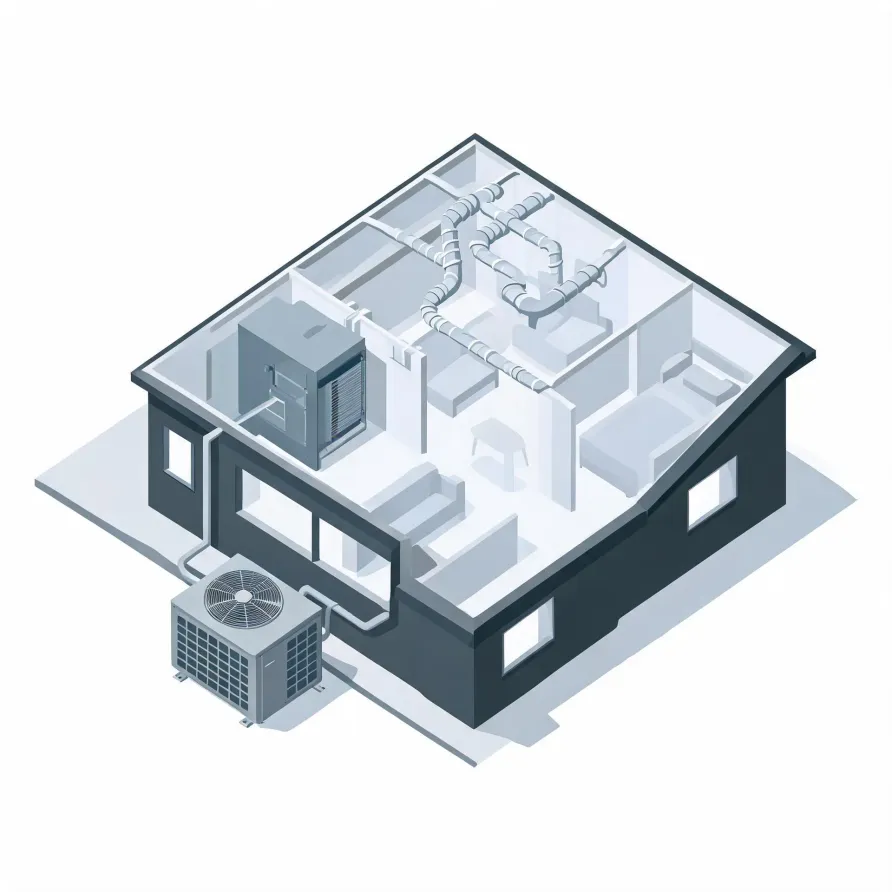
The outdoor condenser unit sits outside the house and holds the compressor, which is the part contractors look at first when a system stops cooling. The condenser coil wraps around the outside of that cabinet and sheds heat to the air. When either of those fails, the whole system loses its ability to move heat out of the house.
Inside, the air handler or furnace cabinet holds the evaporator coil and the blower. The evaporator coil sits above or beside the furnace and is where refrigerant absorbs heat from indoor air. The blower pushes that air across the coil and through the house, so a fault in either one shows up quickly as weak airflow or warm air at the registers.
The drawing shows the general layout of a central AC system, and a licensed contractor determines which components apply and what condition they are in for your specific home.
Find a contractor in Cabarrus CountyCabarrus County, by the numbers
100 severe weather events were recorded in Cabarrus County, North Carolina between 2015 and 2024.
NOAA National Centers for Environmental Information, Storm Events Database, bulk CSV export, events 2015-01-01 through 2024-12-31.Half the homes in Cabarrus County, North Carolina were built in 1997 or earlier (2020-2024 ACS 5-year).
U.S. Census Bureau, 2020-2024 American Community Survey 5-Year EstimatesCabarrus County, North Carolina holds 93,691 housing units (2020-2024 ACS 5-year).
U.S. Census Bureau, 2020-2024 American Community Survey 5-Year EstimatesOwners occupy 71.2% of the occupied homes in Cabarrus County, North Carolina (2020-2024 ACS 5-year).
U.S. Census Bureau, 2020-2024 American Community Survey 5-Year EstimatesCodes & Standards Governing Central AC Repair in Cabarrus County, North Carolina10 rules & standards on record
What the repair visit looks like
Split-system central air conditioners rated below 45,000 Btu/h manufactured on or after January 1, 2023 must meet a federal minimum of 13.4 SEER2.
Split-system central air conditioners rated at or above 45,000 Btu/h manufactured on or after January 1, 2023 must meet a federal minimum of 13.4 SEER2.
Split-system central air conditioners manufactured between January 1, 2015 and December 31, 2022 had to meet 13 SEER, the metric that preceded SEER2.
Single-package central air conditioners manufactured on or after January 1, 2023 must meet a federal minimum of 13.4 SEER2.
Space-constrained central air conditioners manufactured on or after January 1, 2023 must meet a federal minimum of 11.7 SEER2.
Federal efficiency standards for split-system central air conditioners and heat pumps are set on each certified combination of outdoor unit and indoor coil rather than on the outdoor unit alone.
Residential and light commercial air conditioning and heat pump systems assembled in the field, including mini-splits and unitary systems, may not be installed on or after January 1, 2025 using a refrigerant with a global warming potential above 700.
A field-assembled system whose specified components were all manufactured or imported before January 1, 2025 carries no installation compliance date under the refrigerant restrictions and may still be installed.
Licensing Rules for HVAC Repair in Cabarrus County, North Carolina
North Carolina issues Class I heating licenses covering all systems in all structures, and Class II licenses covering heating systems in single-family detached residential dwellings.
North Carolina requires a license before any person or firm may engage in, or offer to engage in, the business of heating contracting.
Severe Weather Events in Cabarrus County
Weather puts real hours on cooling equipment. Storms, heat, and humidity cycles stress compressors, coils, and electrical components in ways that show up as repair calls, and what that load looks like in Cabarrus County shapes what a local contractor sees year over year.
100 severe weather events, 2015–2024. Source: NOAA National Centers for Environmental Information, Storm Events Database.